Engineered Trading Strategies
What Are Engineered Trading Strategies? Is it necessary to have a strategy?

By examining real market evidence, the answer to the second question becomes clear and straightforward: in financial markets such as cryptocurrency or binary options, it does not matter whether you are a professional trader or a beginner investor—if you do not have a trading strategy, failure is almost inevitable. Entering the market without a strategy is like entering a battlefield without a battle plan.
Now let us address the first question. Trading strategies refer to the set of rules and actions that traders follow under different market conditions, especially during critical or uncertain situations. With a clear strategy, a trader can continue the trading process calmly and avoid unnecessary stress, even when the market becomes difficult.
Most beginner traders allow their emotions to influence their decisions, and this often leads to serious and sometimes irreparable losses. In contrast, traders who follow a well‑defined plan do not allow temporary emotions to control their actions. Instead, they remain focused on their process and their long‑term objective.
Having an engineered trading strategy provides two major advantages:
- You know exactly when to trade and what action you plan to take before entering the market.
- A clear strategy helps prevent harmful emotions from interfering with your decisions, as long as you consistently follow the strategy.
A strategy must be tested repeatedly through backtesting and its effectiveness should be carefully evaluated under different market conditions. However, even after thorough testing, the real‑world performance of a strategy can still be influenced by two important factors, which may cause its success rate to differ from the results observed during testing.
The first factor is the market itself. A strategy may not perform equally well under all market conditions. For example, it may behave differently in weak markets with low trading activity compared to strong and active markets. Its performance may also vary between different trading sessions, during major news events, or under other changing market conditions. Over time, the effectiveness of a strategy may even decline to the point where it is no longer useful. Therefore, one of the main challenges in maintaining consistent risk control is the changing nature of the market itself.
The second factor is the human factor. One of the main benefits of having a strategy is controlling the trader’s emotions. However, this benefit only exists if the trader truly follows the strategy. Commitment to the strategy is what often distinguishes professional traders from beginners.
Engineering trading strategies

If a trader begins to doubt the strategy during a trade, the second purpose of the strategy has already failed. Doubt usually indicates that the trader has not fully accepted the strategy’s logic or performance, and this often leads to poor decisions.
Before placing any trade, a strategy must be tested thoroughly under consistent market conditions. Once its effectiveness has been evaluated and accepted, the trader must follow it with discipline—even if individual trades do not go as expected. Becoming a successful trader requires practice and discipline; before winning trades consistently, one must first learn to become a disciplined trader.
Engineered Trading Strategies
A trader can modify or replace a strategy if it proves ineffective. However, it is much more difficult to change habits formed through inconsistency, doubt, or lack of commitment. These habits can cause failure regardless of which strategy is used.
Once we understand the concept and benefits of a strategy, it becomes clear that the role of strategy is the same across all financial markets, whether in Forex, cryptocurrency, or binary options trading.
Types of Strategies Based on Their Objectives
Trading strategies can differ based on how they define their targets.
Engineered Trading Strategies
Are we already losers in binary option?
How is the risk-to-reward ratio in binary option?
Will a trader be more successful in Forex than in binary option?
The first important thing is having a tested strategy—a strategy whose performance has been tested repeatedly under the desired market conditions, and one that we believe in and are committed to following.
Now let us assume that the market has created a suitable opportunity according to our strategy, and we have decided to enter either a buy or a sell trade. The first step is to determine the Risk‑to‑Reward (R/R) ratio for this trade according to our strategy.
Naturally, risk is an inherent part of every trade. Let us assume that during the day we decide to risk 2% of our assets, and the probability of our strategy being triggered is once per day. This means that we are placing our entire daily risk on that single trade. However, the probability of the strategy being triggered may be higher—for example, 2 or even 4 times per day.
In that case, we should divide the 2% risk by the number of trades we expect to take, ensuring that the total risk equals our predefined daily risk. Some positions may require slightly more or less risk depending on the strategy, but in any case, the total risk should be equal to the daily risk.

Some engineered trading strategies have a favorable Risk‑to‑Reward ratio, such as 1:2 or 1:3, which are very desirable. However, in binary options, all strategies have a Risk‑to‑Reward ratio of less than 1:1.
For example, if the payout of a binary trade is 90 percent, the Risk‑to‑Reward ratio becomes 1:0.9. In other words, you do not even receive a reward equal to the risk you take. This means that if the strategy performs with a 50 percent probability under uniform conditions, the total trades will ultimately move toward a loss. Therefore, mathematically speaking, with a strategy that has a success rate of less than approximately 55%, you will eventually be a losing trader.
It is similar to participating in a coin‑toss game where the losing side of the coin is slightly heavier than the winning side. If your strategy cannot compensate for this built‑in bias in the coin, you will effectively become the loser.
However, strategies in the Forex and cryptocurrency markets differ from those in binary options. Strategies in binary options are entirely time‑dependent, meaning that the timeframe of the trading candle must end before the result of the trade is determined.
This timeframe can even be as short as 5 seconds. These short timeframes may be attractive to many traders, especially when they use a well‑performing and backtested strategy at the appropriate time and also adhere to proper capital management. The appeal of binary trading lies in achieving quicker results, without strict limitations on position size.
Engineered Trading Strategies
Do we have a mathematically successful strategy in binary options?
Some consider trading in binary options to be pure gambling. What is your view on success and developing a strategy in binary options?

A strategy is considered successful when its performance has been tested multiple times and its win rate follows the formula below:
Win Rate > (1 / (1 + Payout Ratio)) * 100
For example, if the payout is 80 percent:
Win Rate > (1 / (1 + 0.80)) * 100
Win Rate > 55.55
This means that under these conditions, the minimum performance of our strategy should be 55.55 percent so that we do not incur a loss.
You can download and use the Excel formula for calculating the strategy’s win rate for free from the link below for your convenience.
Naturally, considering the matter explained above, trading in currency pairs or markets with less than an 85% payout in binary options is not recommended at all. The binary management software also prevents trading under conditions with lower payouts.
Engineered Trading Strategies
What does risk distribution in binary mean?
As we mentioned, we first need a tested strategy that meets the minimum performance conditions. According to the formula, the slope of our trading results should be upward, not downward.
But we know that strategies are a set of rules established by the trader that activate a buy or sell trade when certain conditions are met. After a trade is completed, we must wait for the strategy to activate again. Regardless of the outcome of the previous trade, the next trade will be activated when the conditions appear again. In other words, your strategy is independent of the results of your previous trades and simply acts as a green light for entering a trade.
Now let us assume that our strategy has a 60% win rate, which we have tested multiple times. According to the formula, the minimum payout must be above 67% so that the overall result of our trades does not move into a negative slope. However, if the selected payouts are higher, the overall performance trend will be positive and the trades will be profitable.
Now we need to talk about a very important topic in evaluating the performance of a strategy. What exactly do we mean when we say that the win rate of our strategy has been independently tested at 60 percent?
Naturally, the answer is that we have tested our strategy through a large number of trades when the market activated our strategy, and in the end we achieved a 60% win rate across all trades.
Yes, this is completely correct, but an important issue still remains hidden here: the number 60 is the final average.
Engineered Trading Strategies
Is our drawdown also acceptable?
Let me give you an example. Consider a climber who secures their rope to anchors along the route to prevent a sudden fall. Sometimes an anchor might come loose, and the climber falls to the previous anchor (a failed trade). Perhaps the next anchor is also weak, leading to another fall. But we know that the route has been tested for the climber many times, and eventually the climber will reach the summit.
However, will this climber be able to withstand multiple long falls in succession? After a fall longer than he ever imagined, will he not be filled with fear and worry? Do his tools allow him to withstand one or more consecutive falls?
This is the same as drawdown. Even though our strategy has recorded a 60% win rate, have there been situations along this path of a 60% success rate where it experienced significant drawdowns, to the point of occasionally approaching the danger zone of capital loss?
Will our capital and our character be able to withstand such declines along the way? Will our capital be wiped out before reaching the goal?
If the drawdown of a strategy resembles the regular blades of a saw and the overall slope of the path trends upward with a 60% success rate, it is acceptable and good.
However, if the slope of those blades varies and exceeds the trader’s expectations—for example, when there is a series of consecutive losses—can the trader recover before losing their capital?

The human mind naturally reacts to streaks, meaning a series of wins or a series of losses in succession. This is a weakness. Even though we know that continuing with the strategy will eventually lead to success, emotions can cause these streaks to feel longer and distract us from our goal. It may even lead to a lack of precise adherence to the strategy and make it ineffective.
So what should we do now?
Our software includes several management systems whose job is to distribute risk. If your strategy’s drawdown exceeds the defined standard or your trading risk goes beyond the allowed limit, the software interrupts the losing sequence and stops you. This is the assistant we need—something that stands over us and monitors our trades.
Engineered Trading Strategies
What points should we consider when backtesting a binary options strategy?
The most important aspect to consider when backtesting a strategy is checking for a statistical edge. Is your backtest consistently above the breakeven point?
If the answer is yes, the capital management we provide, through risk distribution, will lead to the growth of your capital. However, if the answer is no, our capital management can only reduce the speed of your decline and loss.
After hitting the stop‑loss according to your capital limits, the software will completely shut down, preventing you from trading again and giving you the opportunity to review your strategy and avoid further losses from the start.
Therefore, scenarios where the win rate does not align with the formula provided in our article will be doomed to fail from the beginning, and our risk distribution and capital management program can act like rock‑climbing anchors, preventing a final fall and keeping you alive for another ascent—of course with new, properly tested engineering trading strategies.

In our rock‑climbing metaphor, capital management is like the rope secured to the anchors along the route, and strategy selection is like choosing a climbable wall. If the backtest of the strategy is not satisfactory and the drawdown is unacceptable, it is as if the chosen wall does not slope upward at all but instead slopes downward into the valley, and the rope only prevents a catastrophic fall.
Of course, our software is useful for traders using any strategy, even incorrect ones, whether during an ascent or a descent (slowing the descent and creating an opportunity to change the strategy).
However, you must understand that we do not produce strategies. If your strategy is ineffective, you need to reconsider it; this is truly necessary.
Engineered Trading Strategies
So how do I start trading in binary options?
1.Have at least 300 to 500 real trades or recorded backtest trades.
2.Calculate the actual win percentage (use the provided Excel sheet for assistance).
3.Compare it with 55.5 percent (the number obtained from the payout formula) and measure its distance from this value.
4.Consider the actual payout in the software for each trade.
5.Keep the risk in trades below 2 to 3 percent so it does not destroy the variance of your capital (preferably below 2%).
6.Check the losing streaks in the backtest to ensure they have not gone below the breakeven point and are reasonable (acceptable drawdown).
7.Check the standard deviation of the results (to observe the strategy’s volatility).
If your strategy is still above the minimum derived from the formula, congratulations—you have built a system, a system based on statistics and financial engineering, not on gambling, because you know the market is a ruthless teacher that only respects statistics.
Engineered Trading Strategies
How do losing streaks destroy us?
Let’s assume the actual win rate of your strategy is 58 percent, and an 80 percent payout on trades seems reasonable.
But with the same win rate, there is also a possibility of having 6 consecutive losses:
(0.42)^6 = 0.005
That means there is a 0.5% chance. In other words, in 1000 trades, you might experience a streak of 6 losses about 5 times.
This streak can seriously damage your account. Here, the concept of Risk of Ruin becomes apparent, meaning the risk of destruction—the probability that your capital will be destroyed before reaching the statistical edge.
That means if your position size is large, it can even lead to the destruction of your capital, even when you have a positive edge.
Engineered Trading Strategies
Determining position size in strategies?
When you do not know how to set the trade amount according to your strategy, our software system adjusts the position sizes based on your previous trade and the management system you have chosen, preventing illogical targeting.

Which risk management system you use in our software completely depends on your trading personality and the market conditions ahead of you, and it is necessary to study the explanations of these systems within the software. Some of them perform strongly during consecutive wins, while others are more sensitive to losses and help prevent entering losing streaks. Some increase positions arithmetically.
If you unintentionally enter a losing streak, the system provides the necessary alerts to stop trading in time. As we discussed earlier, the probability of entering these streaks can be calculated based on the backtest of your strategy, and it is a realistic occurrence. Therefore, immediate alerts are necessary if you enter such a streak.
This is done by setting an alert point before the stop and after it, eventually reaching the stop‑loss and closing the possibility of opening a new trade in the software.
1.If you increase the risk, longer streaks can lead to account destruction.
2.If your strategy has no edge, you will not achieve results with any risk management system.
Engineered Trading Strategies
Mathematical analysis of the statistical edge in binary trading?
Mathematical analysis of the statistical edge in binary trading:
Edge means a positive expected value.

According to the formula:
Edge = (Win Rate * Profit per Win) – (Loss Rate * Loss per Loss)
If Edge > 0, you have an advantage.
If Edge = 0, the game is fair and balanced.
If Edge < 0, the game is rigged against you.
In terms of the rock‑climbing metaphor we mentioned, the edge represents the slope of the rock. If the slope is positive, it means we have an edge, and then placing anchors and moving toward growth becomes possible.
But with a negative slope, it means moving toward a cliff, and if one remains on this path, it will ultimately end in a fall. However, capital management software can still be effective and leave the trader with a way back.
Having an edge is determined through a large number of backtests. The edge should be obtained according to statistical data, not through subjective estimation, especially a subjective one that always favors wins and poetically handles losses.
The market is the enemy of statistical errors; engineers are friends with statistics, especially when it comes to Monte Carlo.
Monte Carlo works contrary to gambling; it uses statistical data instead of hope. Monte Carlo relies on statistical repetition.
Before explaining Monte Carlo operations on the strategy, it is necessary for traders who do not intend to use it to understand that the risk management system we provide does not play a role in determining your strategy. However, as we mentioned earlier, it can cut losing streaks and prevent a final collapse and loss of capital caused by choosing an unreliable strategy.
Therefore, it is essential to pay attention to all its warnings and limitations when using it and not to act outside of them, so that it can accompany you in achieving success.
Engineered Trading Strategies
Strategy analysis with Monte Carlo?
If your strategy’s win rate is 58% and the market payout is 80%, instead of choosing a single 1000‑trade path, we try 1000 random paths. That is, we create a list of trades with a 58% win rate and a 42% loss rate, update the capital after each trade, and repeat this process for, say, 10,000 trades.
After it ends, we examine the worst‑case scenarios. How much capital loss occurs? What is the maximum drawdown in most cases? What percentage of paths temporarily drop by 30% to 40% despite having a positive edge? Because even with a positive edge, several initial trades might be losses. This is variance—the natural noise of probabilities—and you need to survive even in the worst‑case scenarios.
You must be able to withstand potential drawdowns; otherwise, even a system with a positive edge will not work for you. Therefore, Monte Carlo can confront you with possible futures.
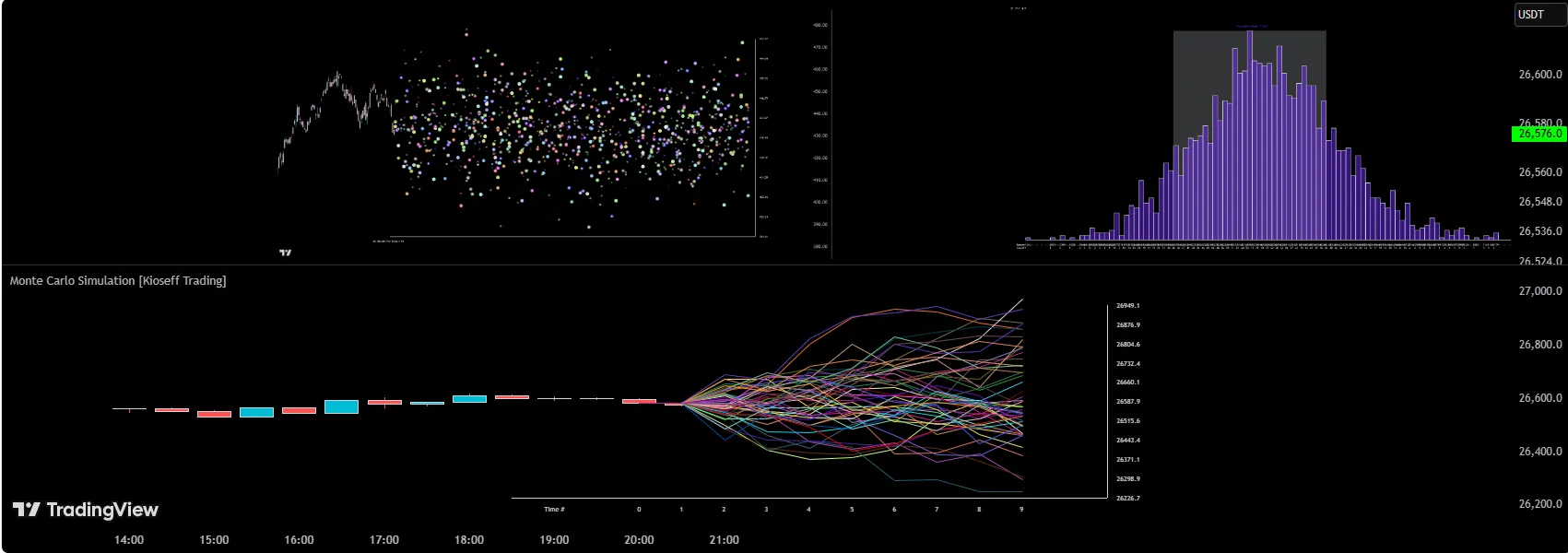
What information do we obtain from Monte Carlo for binary options trading?
- Average capital:
If everything proceeds according to probabilities, what level of growth is expected?
- Minimum capital in the paths (Worst Case):
It shows how large the worst possible drop is before recovery. Here, the psychological aspect is crucial. If you cannot withstand a 30% drop, even a positive edge cannot be realized.
- Percentage of successful paths:
For example, out of 1000 simulated paths, in what percentage of them does the capital exceed the expected amount?
- Percentage of paths with severe drawdown:
It shows how likely it is to experience a significant loss before actual growth begins.
The binary options market is volatile. A few wins or losses in a row (streaks) can mislead the mind. Monte Carlo provides a realistic picture of risk and long‑term growth. Capital management and position sizing only make sense when you understand the range of possible outcomes.
You can use this method for proper and engineered statistical analysis and conduct your evaluation. We provide a sample Excel file for this analysis for each of the systems free of charge. If you like, you can also watch the Monte Carlo training course videos on our YouTube channel.
Engineered Trading Strategies

Download : Probability And Risk Management In Binary Options
If you do not intend to perform Monte Carlo statistical calculations or find them difficult, just know that these calculations are mainly used for selecting and comparing the best possible strategies, especially in terms of drawdowns. However, these results are still based on probabilities.
To compare and understand strategies, you must know that losing streaks can always occur and may lead to capital destruction. But before that, the strategy must have a statistical edge, which we have already explained, and all of this must be accompanied by proper risk and capital management.
It is important to become familiar with our four risk and capital management systems and choose one that suits your strategy or your trading personality, so that it can provide the required position size for the next trade based on your previous trade.
Stay in touch with us.
If you have any questions or would like to discuss related topics, please send us a message.
Engineered Trading Strategies
Our Team
The author of this article

Mr.Kadkhodaei
Engineer and programr
To receive the article and related files, you can send a message to our colleague’s personal email.